Engineer's Corner
Complete technical breakdown of GT systems. Calculations, algorithms, fault tolerance, and honest answers to hard questions. For engineers who ask the right questions.
System Overview
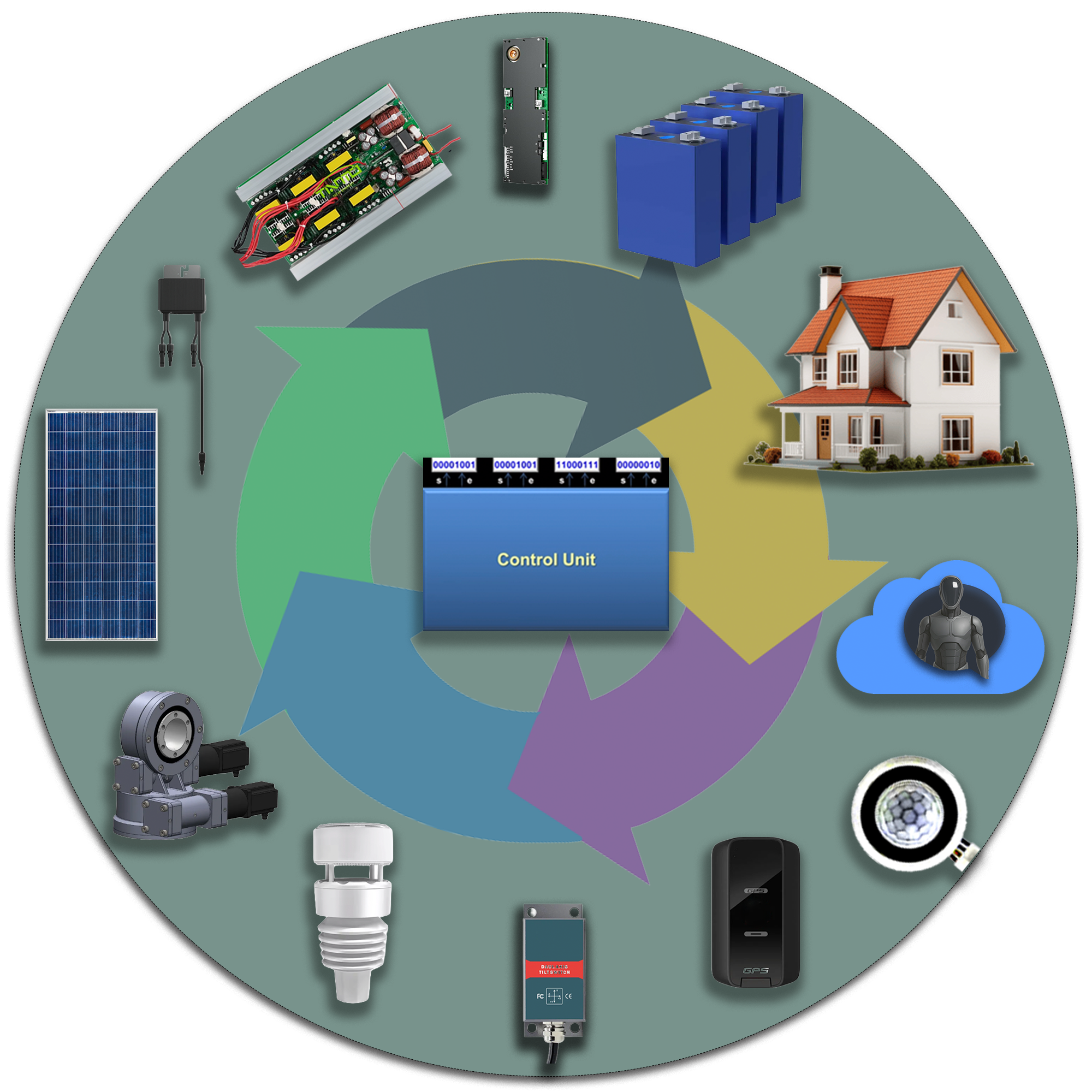
Key Specifications
1. Choosing the Right System
GT solves the problem of autonomous power supply.
If wind is more effective for your location than solar — we'll tell you directly.
Three Types of Solutions
| Type | When Suitable | GT Product |
|---|---|---|
| Solar Station | Average annual wind <8 m/s, good insolation | HSS Lite / HSS Core |
| Wind Generator | Average annual wind >10 m/s, frequent storms | GT Wind 2kW |
| Hybrid | Variable conditions, seasonality | Solar + Wind + shared storage |
Where Solar Stations Are NOT Recommended
We do not recommend installing solar stations in locations with:
- Average annual wind speed >12 m/s
- Regular storms (gusts >25 m/s for weeks)
- First line of open coastline without wind protection
Examples: Baltic coast (Svetlogorsk, Klaipeda), Western Netherlands, Atlantic coast of Portugal/France, Northwestern Germany (Frisian Islands), Western Ireland and Scotland.
For these locations we recommend: GT Wind 2kW as primary source, solar station behind the house or fence — in wind shadow.
iONE's Role in System Selection
AI assistant iONE is connected to meteorological APIs and before purchase analyzes: average annual wind speed, storm frequency, monthly insolation, terrain and shading.
If the location is not suitable for a solar station — iONE will warn and offer an alternative.
2. Mechanics and Wind Resistance
Foundation Structure
The station is mounted on 6 screw piles, 89 mm diameter, 1.6–1.8 m length, galvanized S355 steel. Distributes load, eliminates tipping, no concrete required.
Load-Bearing Frame
Galvanized steel 100×100×8 mm, bolted connections (no welding). Galvanization service life: 25–30 years. Rubber-metal dampers absorb shock loads during gusts.
Mast and Drive
Central mast: aluminum profile with internal cable channels ("mast-in-post"). Main drive: slewing drive SDE3-62-R, self-locking worm gear with 62:1 ratio.
| Tilting moment capacity | 17 kN·m (static load-bearing) |
| Self-locking torque | 3.7 kN·m (holds position without power) |
Wind Load Calculations
| Parameter | Formula | Values | Result |
|---|---|---|---|
| Wind pressure | q = 0.5 × ρ × v² | ρ=1.25 kg/m³, v=30 m/s | 562 Pa |
| Wind force | F = q × Cd × A | Cd=1.2, A=25 m² | 13.8 kN |
| Moment on tracker axis | M = F × L | L=1.5 m | 20.7 kN·m |
| Moment on drive | M_drive = M / i × η | i=62, η=0.4 | ~8 kN·m |
Safety margins: Drive torque: 2.1–2.3×. Entire system (mast, supports, flanges): ≥1.8×. At 30 m/s wind, mechanics operate within 55–60% of allowable limit.
Storm-Park and Half-Park
When wind exceeds 15 m/s, the system automatically moves panels to safe position:
- Half-park: intermediate tilt for partial generation and reduced wind load
- Storm-park: horizontal position with minimal wind exposure
Entry: wind >15 m/s for 10 sec. Exit: wind <12 m/s for 60 sec.
3. Electrical and Thermal
MPPT and Inverter
Dual MPPT — each panel string operates independently. Input voltage: 120–500 V, efficiency 97–98%. Built-in protection: OV, UV, OC, OT, SPD.
Passive Cooling
Heat dissipated through graphite thermal pads to aluminum enclosure. No fans = no clogging, no noise. Stable from –30 to +55°C ambient.
Active BMS Balancer
Bidirectional charge transfer between cells. Operates at low temperatures, reducing heating and losses.
LiFePO₄ Cells
Capacities: 206, 280, 314 Ah. Configurations: 8S (24 V, HSS Lite) and 16S (48 V, HSS Core). Operating range: –35 to +60°C.
Cell Lifespan
| Depth of Discharge (DoD) | Cycles to 80% capacity |
|---|---|
| ≤30% | up to 10,000 |
| 80% | ~3,000 |
| 100% | ~2,000 |
Conditions: 25°C, current ≤0.3C.
4. IoT, Server, and AI
Telemetry (every 15 seconds)
- Power generation and consumption
- Currents and voltages per panel string
- Cell, inverter, controller temperatures
- Wind speed and direction
- Tracker position (azimuth, tilt)
- BMS status (cell voltages, balance, errors)
- Connection quality, GPS status
Communication
Wi-Fi, LTE, Ethernet. Average traffic: ~120 MB/month. All telemetry encrypted (AES-256), stored in France (GT Cloud), backup in Germany.
Controller Autonomy
Local buffer: 72 hours (SQLite). During connection loss, data accumulates and syncs after restoration. Station operates fully autonomously.
AI Monitoring
| What It Monitors | How It Detects | What It Means |
|---|---|---|
| Panel degradation | One string produces 15% less under same sun | Contamination, microcrack, defect |
| Drive wear | Motor current increased 20% over a month | Needs lubrication or reducer check |
| Cell imbalance | Voltage delta grows after balancing | One cell degrading faster |
| Anemometer anomaly | Readings don't correlate with regional weather | Sensor contaminated or faulty |
| Overheating | Inverter temp above normal at same load | Heat dissipation deteriorated |
5. Fault Tolerance
| Failure | Detection | System Response | Who Knows First |
|---|---|---|---|
| Panel degradation | AI detects reduced output | Notification | GT → customer |
| Drive wear | AI detects current increase | Preventive maintenance | GT → customer |
| Cell imbalance | BMS + AI trend | Increased balancing | GT → customer |
| Anemometer fault | No data or CRC error | Enter HALF_PARK | Simultaneous |
| GPS lost | No fix >5 min | Light sensors + clock | Automatic (±2°) |
| Drive jammed | Current >150% | Stop, notification | Simultaneous |
| Connection lost | No response 72 h | Autonomous mode | System continues |
| Critical failure | Emergency code | Safe mode, urgent dispatch | GT → immediate |
Each critical function has a fallback:
• No GPS → light sensors + clock
• No anemometer → safe position (Half-park)
• No cloud → autonomous operation with local storage
6. Proactive Service
GT service: System detects anomaly → GT analyzes → GT calls customer → prevention before failure.
Response Levels
| Level | What Happens | Response Time | Action |
|---|---|---|---|
| 🟢 Observation | Parameter deviated but within normal | — | Logged, trend monitored |
| 🟡 Attention | Trend leads to problem in weeks | 48 h | Notification, visit planning |
| 🟠 Action Required | Parameter out of range, system works | 24 h | Contact, diagnostics or dispatch |
| 🔴 Critical | Risk of failure or damage | 4 h | Safe mode, urgent dispatch |
Real Example
Station #1847, Munich. AI detected: azimuth drive current increased from 1.2 A to 1.8 A over 3 weeks. Diagnosis: likely thickened lubricant or sand in reducer. Action: service visit, drive maintenance. Result: prevented worm gear wear, customer didn't notice the issue.
What This Gives You
- Minimum downtime — problems solved before failure
- Transparency — see system status in the app
- Peace of mind — GT monitors 24/7
- Long lifespan — prevention instead of repair
7. GT vs. Typical Market Solutions
| Component | GT | Typical Alternatives |
|---|---|---|
| Drive | Self-locking worm gear 62:1, no power to hold | Ball-bearing with external brake, drift 1–2°/hour |
| Frame Dampers | Rubber-metal mounts absorb impacts | Rigid welded → microcracks after 1–2 years |
| Cooling | Passive via aluminum, no fans | Forced cooling — filters clog, failure points |
| BMS | Active balancer, bidirectional transfer | Passive resistive → losses and uneven wear |
| Sensors | Anemometer + inclinometer + GPS + light | Only GPS and encoders, no wind data |
| MPPT | Independent for each string | Single shared — shading drops entire chain |
| Materials | Aluminum, galvanized steel, bolted, IP65 | Black steel, welding, plastic cable entries |
| Service Model | Proactive — GT detects issues first | Reactive — customer reports problems |
8. Skeptic's FAQ
9. GT Engineering Philosophy
We show it in detail so engineers can see how a reliable system emerges from countless deliberate decisions.
Every bolt, every cable, every sensor has its engineering rationale.
Every element — from screw pile to server — is calculated, verified, and interconnected.
Where stability in other systems is a matter of chance, in GT it's a matter of design.
GT doesn't just sell hardware.
GT monitors, predicts, and prevents.
We know about problems before you do — and we solve them before they become failures.
10. Documentation
Datasheets and certificates for all components available upon request:
- Solar panel specifications and IEC 61215 certificate
- LiFePO₄ cell datasheets (206/280/314 Ah)
- UN38.3 and IEC 62619 battery certificates
- Slewing drive technical specifications
- Inverter datasheet and IEC 62109 certificate
- Sensor specifications (anemometer, inclinometer, GPS)
- BMS technical documentation
- IP65 enclosure certifications

"The chef's secret is simple - use good ingredients and love what you do."
Ivan Gorb, CEO of GT GmbH